
 EN
EN  ES
ES  IT
IT  FR
FR  ZH
ZH  PT
PT 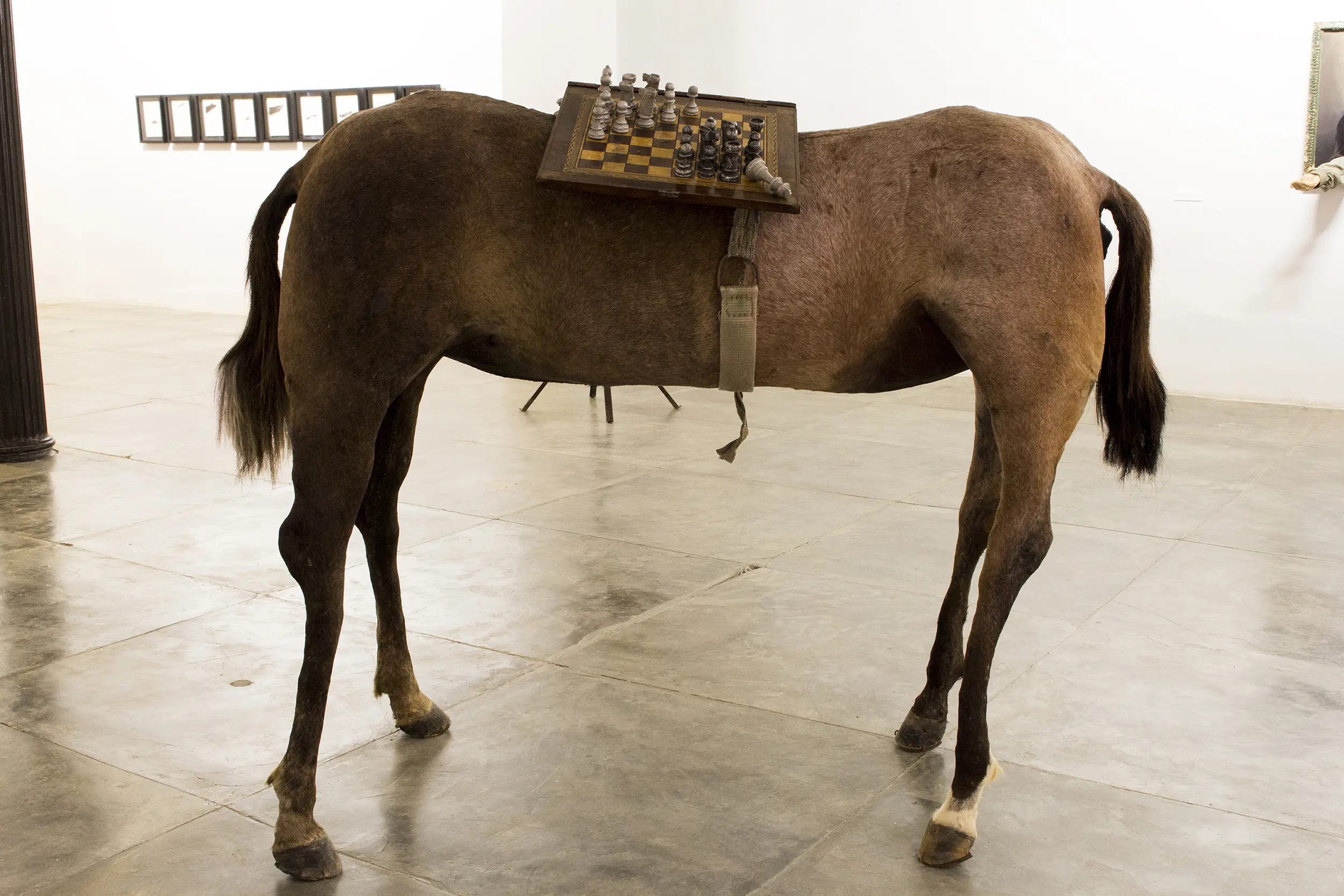
The soliloquies of Céspedes. From the series: Index of
Images.
Mule taxidermy, chess set and straps.
135 x 75 x 181 cm
- Chess board and chess pieces belonging to Fernando Figueredo Socarrás, donated by Carlos Manuel de Céspedes del Castillo.
- Taxidermy work commissioned by Major General Francisco Javier Céspedes to Miguel Bravo Santíes, physician and amateur biologist, former secretary of Céspedes; made with two mule haunches from the San Lorenzo farm.
The curious piece is based on an anecdote by Céspedes, who tells of having seen one of his mules, Candela, give birth to a deformed Siamese calf that, surprisingly, was born alive and walked a few steps before dying just a minute later. The mule had apparently been ridden by the donkey Masón, on which Céspedes carried his personal belongings. Since mules are generally sterile, when they give birth, their offspring are usually weak or have abnormalities that do not survive birth.
The image of the object was used by the organization chaired by Bravo, Brothers of Silence, which would give rise to the ill-advised sedition of Lagunas de Varona. The emblem designed for the secret “cespedista party” incorporated, on the animal's rump, a chessboard where a single white king appeared, with all its pieces gathered at the opposite end. In Bravo's words, when explaining the reasons for his conspiracy:
“A headless Republic where those of the same species no longer speak the same language and do not understand each other (...) the board is a metaphor of the betrayal made by the Cubans to the legitimate leader of the Republic, who was a master of the game of chess, an allegory of military thought.”
The Father of the Cuban Nation, Carlos Manuel de Céspedes, spent his last days confined in the mountains of eastern Cuba after being illegally deposed from the presidency of the Republic in Arms. The pages of his diary are filled with passionate reflections on his life, his role in history, his enemies, the revolution and numerous symbolic images that refer to the sensation of an imminent tragic end.
The piece functions as a metaphor of his agony and loneliness, as well as of the recurrent failure in our history caused by an evil that is born from within. The Siamese mules, presented as a historical relic, could be perfectly extracted from the hero's nightmare: the body of a nation divided under the greatest evil of colonialism. On the rump, in a strange chess move, the white king is left alone in front of his own, alluding to how Céspedes was abandoned by the Cubans and left at the mercy of the Spaniards.