The working methodology applied by the artistic duo Ariamna Contino & Alex Hernández in their most recent works derives from the transposition of scientific elements to the field of art. The artists are deeply interested in fundamental issues for the development of contemporary societies: the environmental health of the planet, the balance of social formations, the movement and the diverse dynamics of the human being, among others. Statistics play a decisive role in their research. On many occasions, their starting point is a specific statistical source; however, in their most recent artistic experiences they have developed field work and generated their own statistics, the result of their direct observation. Subsequently, these statistics shape their works and determine both their form and their concept. A global vision of their production allows us to appreciate the peculiar way in which they conceive their works: as landscapes -in exact reference to the concept proposed by the theorist Rosalind Krauss when speaking of expanded sculpture. For them, their landscapes constitute an exercise of total cartography, in which the documentation and the physical and symbolic record of certain biopsychosocial events take precedence.
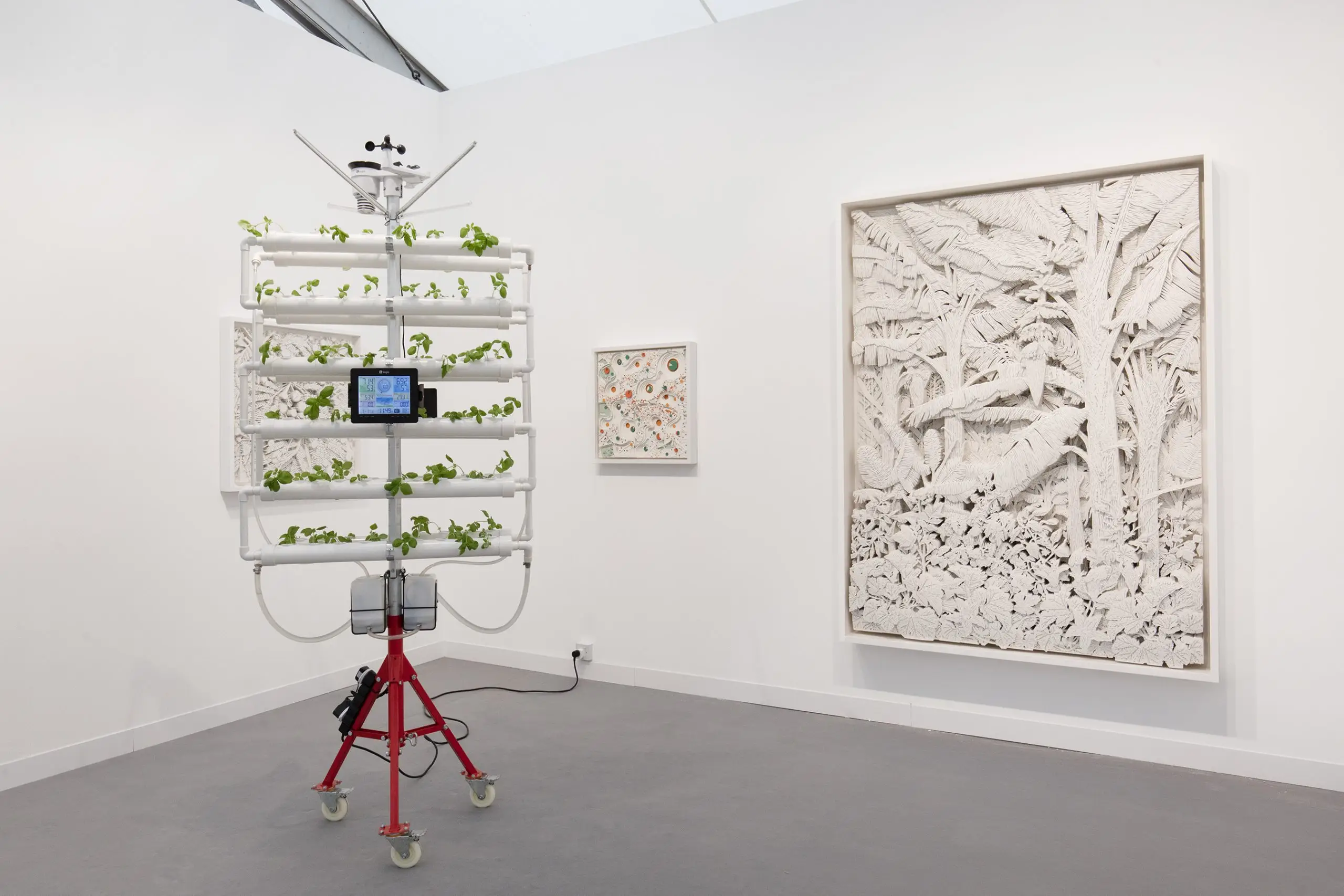
From the series Cartografia Total, Hydroponics, 2024 Industrial PVC hydroponics, led grow lights, weather station, LCD display and tripod 235 x 65 x 65 cm (92.5 x 25.5 x 25.5 in)
This totem-like sculpture is a set of electronic and industrial devices that are commonly used today in the fields of home and organic farming: a hydroponic system, LED lights regulated specifically for cultivation and a weather station equipped to accurately capture the environmental conditions of the site. The interaction of these devices transforms the sculpture into a kind of self-sufficient machinery with two main objectives: on the one hand, to create an ideal environmental system that allows the growth of specific food crops; on the other hand, to record in real time all the environmental characteristics, not of a country or a region, but of a very specific location.
This sculpture can be considered a portable garden, which has already been installed in Mexico City, Miami, Paris, Madrid and now London: a site-specific work that revisits the concept of the expanded field of sculpture, as formulated by the American theorist Rosalind Krauss. Equally significant is the fact that the sculpture generates, through the statistical data it captures in real time, a very precise cartography of our contemporary cities, our domestic spheres and, at this very moment, the scenario in which Frieze London is taking place. The artists will then analyze this statistical material to develop a set of independent works.
The sculpture is part of the project Cartografia Totalalong with three other sculptures, in which the artists have built a series of weather stations equipped with specialized sensors to record environmental variables such as atmospheric humidity, temperature fluctuations and carbon footprint, among others. These indicators allow them to plot a set of proprietary statistics that reflect the human impact on a given environment and the erosion of its ecosystem. The other three sculptures are currently installed in the gardens of the Lázaro Galdiano Museum in Madrid.
From the series Cartografia Total, 2025 Hand cut paper / Watercolor paperboard Fabriano 300 g Cold Press acid-free, and museum glass 200 x 150 cm (78.7 x 59 in)
Per capita bottled water consumption per liter, price of drinking water (liters/day) in contrast to annual per capita beer consumption (liters) and beer prices in supermarkets and bars, barley production in the European Union.
From the series Cartografia Total, 2025
Hand cut paper / Fabriano watercolor cardboard 300 g Cold Press
acid-free, and museum glass 60 x 60 cm (23.6 x 23.6 in)
Percentages of cultivated areas of organic agriculture (2019 and its projection in 2030), compared to the number of beehives for pollination and bee mortality in Europe in the last 10 years.
From the series Cartografia Total, 2025
Hand cut paper / Fabriano watercolor cardboard 300 g Cold Press
acid-free, and museum glass 60 x 60 cm (23.6 x 23.6 in)
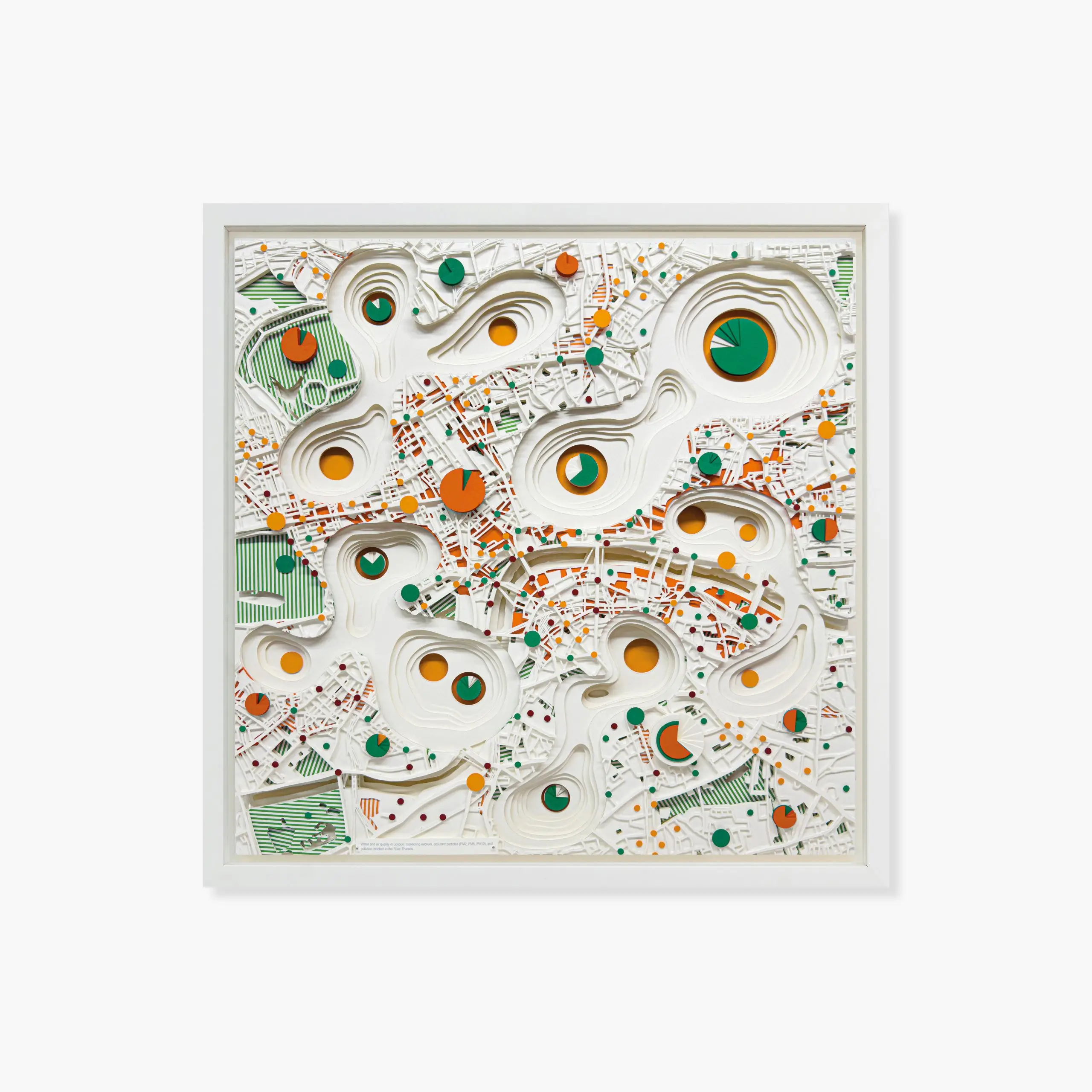
Water and air quality in London: monitoring network, particulate pollutants (PM2, PM5, PM10) and pollution incident in the River Thames.
From the series Cartografia Total, 2025
Hand cut paper / Fabriano watercolor cardboard 300 g Cold Press
acid-free, and museum glass 60 x 60 cm (23.6 x 23.6 in)
Cost of agricultural production in 2023, percentage of freshwater withdrawal destined for irrigation in 2020 and water consumption by sector.
La Huerta, 2025 Hand cut paper Fabriano watercolor paper 300 g Acid-free Cold Press, and museum glass 200 x 150 cm (78.7 x 59 in)
La huerta can be understood as an open door that guides our gaze into a domestic landscape where the branches of various food plants are intertwined: bananas, potatoes, pumpkins, corn, tomatoes, among other fruit and vegetable crops. The starting point of this sculptural relief, created by meticulously assembling 42 layers of hand-cut paper, is a selection of precise botanical drawings of species that are now part of the world's food system. In this work, however, the artist places them within the garden, within the home. The different species are intertwined to form a vegetable skein, reminiscent of the wild domestic landscapes designed by the Brazilian architect Burle Marx during the last century.
From the series La Huerta, Cundeamor, 2025 Hand cut paper Fabriano watercolor paper 300 g Acid-free Cold Press, and museum glass 120 x 120 cm (47.2 x 47.2 in)
The series La huerta represents Ariamna Contino's exploration of a topic of global importance: the search for alternatives that can coexist with the current intensive agricultural model. It functions as a sort of catalog of medicinal plants, fruits and vegetables that can be grown in a home garden in a sustainable way and according to the principles of organic farming. The artist draws her inspiration mainly from botanical illustrations found in encyclopedias and comprehensive studies, mostly produced between the 16th and 19th centuries. The starting point for these sculptural reliefs, created by meticulously assembling layers of hand-cut paper, is a precise drawing of the botanical species in question.
The cundeamor (Momordica charantia), also known as bitter melon, continues to have medicinal and symbolic significance in various cultures. Traditionally, it is valued for its therapeutic properties, particularly for regulating blood glucose and promoting overall health. Symbolically, cundeamor is associated with protection, purification and vitality, and embodies the connection between nature and the care of body and spirit.
From the series El jardín de las delicias (The Garden of Delights), Yopo, 2025 Hand cut paper Fabriano watercolor paper 300 g Acid-free Cold Press, and museum glass 80 x 80 cm (31.4 x 31.4 in)
The series El jardín de las delicias (The Garden of Delights) works as a sort of botanical catalog in which the artist gathers various plants traditionally used for therapeutic purposes, either for their relaxing effects or for the presence of psychoactive or hallucinogenic properties. The artist relies mainly on botanical illustrations found in encyclopedias and exhaustive studies, produced mainly between the sixteenth and nineteenth centuries. The starting point for these sculptural reliefs, created by painstakingly assembling layers of hand-cut paper, is a meticulous drawing of the botanical species in question.
The yopo (Anadenanthera peregrina) is an ancestral plant from South America, famous for its psychoactive seeds, which have been used in indigenous rituals since pre-Columbian times. Traditionally, it serves as a tool for spiritual connection, facilitating states of introspection, visionary experiences and communion with the sacred. Symbolically, yopo represents the threshold between the human and the spiritual, a link to ancestral knowledge and transformative rituals. Its contemporary use in ethnobotanical and artistic studies preserves this symbolic dimension, emphasizing the interconnection between nature, culture and spirituality.
video
Discover some of the manual processes hidden behind the imposing bas-reliefs created by the artists. Ariamna Contino & Alex Hernandez by assembling multiple layers of hand-cut paper.
 EN
EN  ES
ES  IT
IT  FR
FR  ZH
ZH  PT
PT